|
|
|
Korneva I.N., Suzdaleva A.M.
TRAINING STUDENTS IN GENERAL EDUCATION INSTITUTIONS TO PROVIDE FIRST AID TO VICTIMS [№ 4 ' 2025]
Dangerous situations that constantly arise in our lives can be tragic for people, leading to subsequent incapacity for work or disability. Such consequences most often arise due to delays in providing assistance or the unwillingness to provide it. Currently, timely first aid to victims in extreme situations is extremely important. People can get into trouble during natural disasters, manmade accidents and catastrophes, social emergencies, military actions, terrorist attacks, etc. Learning how to properly provide timely first aid to victims is essential. The consequences of injuries and the health of people depend on how correctly and effectively first aid is provided. Effective training of high school students in first aid to victims will increase the frequency and quality of necessary assistance, which in turn will reduce mortality from injuries and emergency conditions. Pedagogical conditions that facilitate the effective preparation of high school students for first aid include the use of innovative teaching approaches, such as case studies, quiz codes, online webinars, debates, presentations, master classes, training sessions, exercises, etc. The experimental study was conducted from 2023 to 2024 at Secondary School No. 56 in Orenburg. Tenthgrade high school students participated in the study. The topic of first aid in Fundamentals of Homeland Security and Defense (FHSD) classes is broad, and general education institutions use a wide range of tools to facilitate students' acquisition of knowledge, skills, and abilities related to the topic under study.
Galaktionova L.V., Vasilchenko A.V., Suzdaleva A.V.
BIODIAGNOSTICS SOILS OF ОRENBURG PARKLAND [№ 6 ' 2015]
The article deals with the prospect of the use of indicators of biological activity of the soil for an adequate assessment of the environmental state of the soil cover of parkland in Orenburg. The current approaches to the diagnosis of soil biological indicators include the definition of the actual and potential biological activity. Potential biological activity indicates the ability of the soil to the implementation of a process under optimal conditions for soil body. It reflects the latent ability to induce a number of biological processes and thus to maintain the constancy of soil parameters. Indicators relevant biological activity reflects the intensity of these processes in real environmental conditions. For a comprehensive assessment of soil processes of tension indicators have been used to date (the production of carbon dioxide and cellulolytic capacity of the soil) and potential (catalase activity and phytotoxicity / seed germination test culture) biological activity in combination with integral indicator of a biological state (IPBS) proposed Kolestnikov C.I., Kazeev K.S., Valkov V.F. (2003). To assess the impact of the urban environment in the soil-biotic complex was carried out determination of the content of mobile forms of heavy metals in soils research facilities. Results of the study revealed the dependence of the volume of carbon dioxide produced by cellulolytic capacity of soils and their hydrothermal regime. Last corrected by human activities in the implementation of measures for the care of green areas. The study of indicators of potential biological activity revealed a statistically significant link them with the content of heavy metals (such as individual items and total content) in soils. The indicator IPBS allowed the authors to make comprehensive conclusions about its dependence on the impact of anthropogenic factors. Reducing the integral index of the biological condition of soil degradation indicates the park area of Orenburg city and oppression intensity exercise of important ecological functions.
|
|
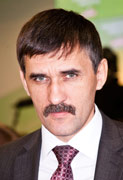
Editor-in-chief |
Sergey Aleksandrovich
MIROSHNIKOV |
|
|